




High Pressure Frac Hose Supplier
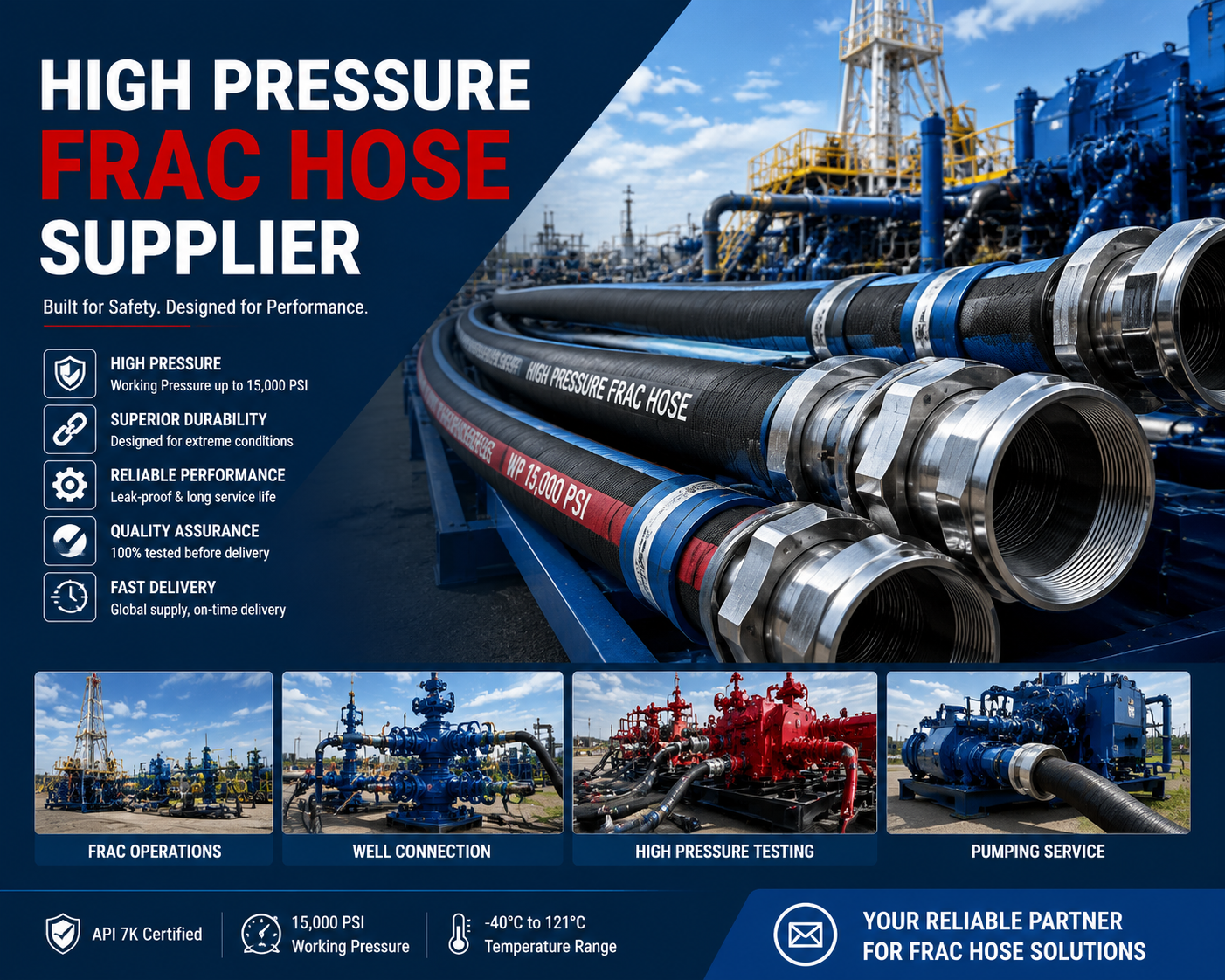
In high-stage hydraulic fracturing, fluid transfer reliability directly impacts wellpad uptime and site safety.
Unconventional shale plays require continuous pumping of abrasive proppants, corrosive chemicals, and
high-velocity fluids at extreme working pressures up to 15,000 PSI. Selecting a certified, high-performance
high pressure frac hose supplier is critical to preventing catastrophic line bursts, reducing downtime
during manifold-to-wellhead hookups, and mitigating vibration stress on rigid flowlines.
This technical guide details the structural specifications, performance benchmarks, and supplier
evaluation criteria required when sourcing heavy-duty flexible fracturing hoses for modern well
stimulation.
- Technical Architecture of Industrial High Pressure Frac Hoses
Unlike standard rubber or industrial transfer hoses, heavy-duty frac hoses are high-grade composite steel-
reinforced pressure vessels. A qualified high pressure frac hose supplier builds multi-layer structures
designed to resist extreme pulsatile forces, internal abrasion, and environmental weathering.
Hose Layer Material Specification Operational Function
Inner Tube
HNBR, Modified Synthetic Rubber, or Ultra-
High-Molecular-Weight Polyethylene
(UHMWPE)
Resists severe proppant erosion (sand/ceramic slurries),
chemical additives, and acidizing fluids (HCl/HF mixtures).
Reinforcement
Layers
4-6 Spiral Layers of High-Tensile Carbon
Steel Wire / Cable Reinforcement
Provides structural integrity under working pressures up to
15,000 PSI with a 2.25:1 or 2:1 safety factor against burst.
Outer Cover
Synthetic Rubber (CR/NBR) reinforced with
Flame-Resistant & Anti-Abrasion Fabrics
Protects against external mechanical abrasion, ozone, UV,
chemical spills, and ambient temperature extremes (-40°C
to +121°C).
End Fittings
Integral Swaged / Crimped Hammer Unions
(Fig 1502/2202) or Flanged Ends (API 6A)
Ensures leak-free, high-integrity pressure coupling directly
to frac manifolds, missile trailers, and Christmas trees.
Kytider Energy Solutions | Technical Publication Page 1 of 4
- Key Specifications & Performance Parameters
When requesting quotations from a high pressure frac hose supplier, engineering teams must evaluate
exact pressure ratings, flow velocities, and bending mechanics:
Working Pressure (WP): Standard offerings range from 5,000 PSI (34.5 MPa), 10,000 PSI (69 MPa), up to
15,000 PSI (103.4 MPa).
Test Pressure (TP): Rated at 1.5 times the maximum working pressure per API standards.
Internal Diameter (ID): Commonly manufactured in 2″, 3″, 4″, and 6″ inner diameters to accommodate
varying barrels-per-minute (BPM) flow rates.
Flexibility & Minimum Bend Radius (MBR): Flexible hose architectures allow up to 30–40% tighter
bend radii compared to traditional rigid steel pup joints, drastically shortening rig-up and rig-down
times.
Engineering Note on Flow Rate Dynamics: Flexible frac hoses reduce hydraulic turbulence caused by
sharp elbows in rigid iron manifold setups. By smoothing flow dynamics, velocity head losses are
minimized:
ΔPloss = f · (L / D) · (ρ · v2
/ 2)
Where f represents the friction factor, allowing for smoother pumping curves and reduced pump truck
wear.
- Why Partner with Kytider as Your High Pressure Frac Hose Supplier?
As a leading exporter of oilfield and energy equipment, Kytider combines factory-direct manufacturing
capabilities with rigorous API quality control. We supply global operators and oilfield service (OFS)
companies with customized fracturing hose assemblies tailored for harsh environments.
Key Advantages of Kytider Frac Hose Solutions:
Full API Compliance & Certification: Built in strict accordance with API Spec 16C (Choke and Kill
Systems) and API Spec 7K, supported by Third-Party Inspection (TPI) options (ABS, DNV, Lloyd’s
Register).
Advanced Anti-Erosion Tube Compounds: Our proprietary inner tube lining yields up to 3x longer
operational life under continuous 100-mesh sand slurry pumping compared to conventional standard
rubber lines.
Vibration Dampening & Safety Buffering: Flexible hose bodies absorb high-frequency pulsation
generated by triplex and quintuplex frac pumps, preventing mechanical fatigue on wellhead valves and
frac trees.
Complete End-Fitting Integration: Fully integrated, pressure-tested end connectors with integral Fig
1502, Fig 2002, or API 6A flanges—factory crimped and hydrostatically tested before shipment.
Kytider Energy Solutions | Technical Publication Page 2 of 4
- Operational Comparison: Flexible Frac Hose vs. Rigid Iron Pipelines
Evaluation Metric Flexible High Pressure Frac Hose Traditional Rigid Steel Frac Iron
Rig-Up / Rig-Down
Time
Rapid (30–50% Faster): Fewer connection
points and high flexibility.
Labor Intensive: Requires multiple swivel joints,
hammer unions, and alignment.
Vibration
Resistance
Excellent: Absorbs pump surge and high-
frequency harmonics.
Poor: Transmits vibration directly to wellhead
connections, increasing fatigue risk.
Erosion / Wear
Points
Uniform Wear: Smooth internal bore with no
sharp directional elbows.
High Localized Wear: Critical erosion at 90° elbows
and swivel joints.
Footprint &
Transport
Compact: Spooled on reels or coiled cleanly in
transport racks.
Heavy & Bulky: Requires dedicated iron trailers and
heavy manual handling.
- Essential QC & Testing Standards Before Procurement
A reputable high pressure frac hose supplier must supply verifiable quality documentation for every
assembly. At Kytider, every length of frac hose undergoes strict factory testing protocols:
Hydrostatic Pressure Testing: Tested at 1.5x Working Pressure held for a minimum of 15–30 minutes,
complete with continuous digital pressure chart recordings.
Electrical Continuity Testing: Ensures static dissipation across metal wire spirals to prevent spark
hazards in volatile gas zones.
Non-Destructive Testing (NDT): Magnetic Particle Inspection (MPI) and Ultrasonic Testing (UT) on end
fittings and swage ferrules.
Full Traceability: Laser-etched serial numbers on end collars linking directly to raw material MTRs
(Material Test Reports) and pressure test certificates.
Request a Custom Quote & Technical Datasheet from Kytider
Need reliable, API-certified flexible frac hoses for your next well stimulation project? Kytider delivers
factory-direct pricing, rapid global lead times, and tailored engineering specs to meet your operational
demands.
Contact Our Engineering Team
Frequently Asked Questions (FAQ)
Q1: What working pressures are available for Kytider high pressure frac hoses?
We supply hoses with working pressure ratings of 5,000 PSI, 10,000 PSI, and 15,000 PSI, with burst pressure
safety margins compliant with international API 16C / API 7K standards.
Kytider Energy Solutions | Technical Publication Page 3 of 4
Q2: Can your hoses handle acidic fluids and slurry mixes?
Yes. Our inner tube liners are specialized compounds engineered specifically to withstand hydrochloric
acid (HCl), matrix acidizing solutions, friction reducers, and heavy sand/ceramic proppants.
Q3: What end connections are available?
We provide integral Fig 1502, Fig 2202, Fig 2002 hammer unions, as well as API 6A flanged end
terminations in carbon steel or stainless steel overlay upon request.