




Химические добавки для нефтяных месторождений
Oilfield Chemical Additives for Oil and Gas Operations
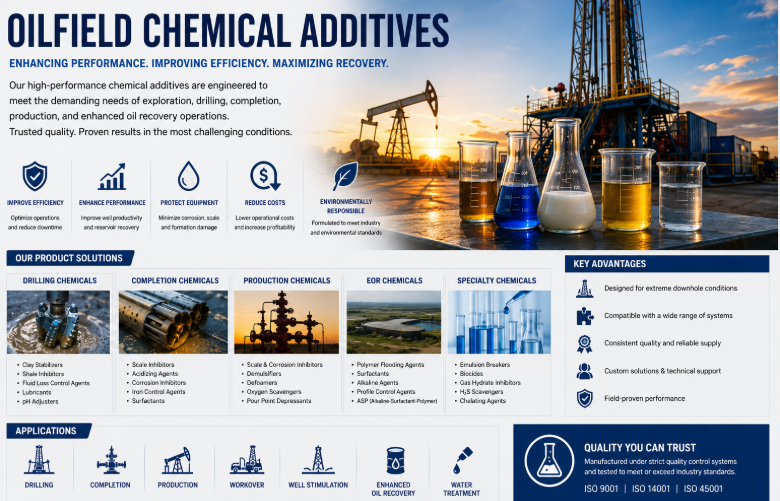
Oilfield chemical additives play an important role in drilling, cementing, fracturing, well stimulation and production operations. They help control fluid properties, improve wellbore stability, protect equipment, reduce formation damage and support safer, more efficient field performance.
For drilling contractors, oilfield service companies and procurement teams, choosing the right oilfield chemical additives depends on the application, formation condition, temperature, pressure, fluid system and project requirements.
What Are Oilfield Chemical Additives?
Oilfield chemical additives are specialty chemicals added to drilling fluids, cement slurries, fracturing fluids, stimulation fluids or production systems. Their purpose is to adjust performance and solve specific field problems.
Common applications include:
- Drilling fluid treatment
- Cementing operation support
- Hydraulic fracturing fluid preparation
- Acidizing and well stimulation
- Scale and corrosion control
- Production chemical treatment
- Wellbore cleaning
- Fluid loss control
- Viscosity and rheology adjustment
Different oilfield operations require different additive systems, so product selection should be based on working conditions rather than a single general formula.
Main Types of Oilfield Chemical Additives
Drilling Fluid Additives
Drilling fluid additives help control mud performance during drilling. They can improve viscosity, reduce fluid loss, stabilize shale, lubricate the drill string and protect the wellbore.
Common drilling additives include:
- Viscosifier
- Fluid loss control additive
- Shale inhibitor
- Lubricant
- Defoamer
- Weighting material
- Filtration reducer
- Dispersant
- Lost circulation material
Cementing Additives
Cementing additives are used to adjust cement slurry performance. They help control setting time, density, fluid loss, strength development and slurry stability.
Common cementing additives include:
- Retarder
- Accelerator
- Fluid loss additive
- Dispersant
- Defoamer
- Expanding agent
- Anti-gas migration additive
- Lightweight additive
Fracturing Additives
Fracturing additives are used in hydraulic fracturing fluids to improve proppant carrying ability, reduce friction, control bacteria, break gel and protect the formation.
Common fracturing additives include:
- Friction reducer
- Thickener
- Crosslinker
- Breaker
- Biocide
- Clay stabilizer
- Surfactant
- Scale inhibitor
- Corrosion inhibitor
Production Chemicals
Production chemicals are used after the well starts producing oil or gas. They help reduce scaling, corrosion, emulsion problems and flow assurance issues.
Common production chemicals include:
- Scale inhibitor
- Corrosion inhibitor
- Demulsifier
- Paraffin inhibitor
- Asphaltene dispersant
- H2S scavenger
- Oxygen scavenger
- Foam control additive
Why Oilfield Chemical Additive Selection Matters
The wrong additive can cause poor fluid performance, formation damage, unstable cement slurry, equipment corrosion or reduced production efficiency. In some cases, a small chemical selection mistake can affect the whole operation.
Reliable oilfield chemical additives help operators:
- Improve drilling efficiency
- Reduce wellbore instability
- Control fluid loss
- Improve cementing quality
- Support fracturing fluid performance
- Reduce corrosion and scale risk
- Protect downhole tools and surface equipment
- Improve production stability
Chemical compatibility should always be checked before field use, especially when multiple additives are used together.
Key Factors to Confirm Before Purchase
Before sourcing oilfield chemical additives, buyers should confirm the actual working conditions and performance requirements.
Important factors include:
- Application: drilling, cementing, fracturing, stimulation or production
- Fluid system: water-based, oil-based, cement slurry or acid system
- Temperature range
- Pressure condition
- Formation type
- Salinity and water quality
- Required dosage
- Compatibility with other chemicals
- Packaging requirement
- Storage condition
- Safety data sheet requirement
- Destination country and transport regulation
For international projects, MSDS, COA, product specification and packing details are often required before shipment.
How to Choose an Oilfield Chemical Additives Supplier
A good supplier should understand field applications, not only chemical names. Many buyers need support to match additives with drilling mud, cement slurry, fracturing fluid or production treatment conditions.
When comparing suppliers, check:
- Experience with oilfield chemical products
- Ability to supply different additive categories
- Technical support for product selection
- Stable quality and batch consistency
- Availability of MSDS, COA and product data sheets
- Export packing experience
- Flexible packaging options
- Fast response for technical confirmation
- Ability to support trial orders and project orders
For oilfield chemicals, stable quality matters because performance changes between batches can affect field operation results.
Information Needed for a Fast Quotation
To receive an accurate quotation, prepare the following details:
- Chemical additive name or application
- Required function
- Fluid system
- Temperature and pressure condition
- Required quantity
- Packaging type
- Destination country
- Required documents
- Delivery time
- Current formula or technical specification if available
If you are not sure which additive is suitable, provide the field application and performance target. The supplier can help recommend a suitable product direction.
Kytider Oilfield Chemical Additives Supply
Kytider supplies oilfield chemical additives for drilling, cementing, fracturing, well stimulation and production applications. Products can be selected according to fluid system, field condition, performance requirement and project use.
Kytider can support customers with drilling fluid additives, cementing additives, fracturing additives, production chemicals and related oilfield equipment supply.
If you are looking for reliable oilfield chemical additives for oil and gas projects, send your application details and technical requirements to Kytider. Our team can help check suitable products and provide a quotation.
FAQ About Oilfield Chemical Additives
What are oilfield chemical additives used for?
They are used to improve drilling fluids, cement slurries, fracturing fluids, stimulation fluids and production treatment systems.
What additives are used in drilling fluids?
Common drilling additives include viscosifiers, fluid loss additives, shale inhibitors, lubricants, defoamers and dispersants.
What additives are used in fracturing fluids?
Common fracturing additives include friction reducers, thickeners, crosslinkers, breakers, biocides, clay stabilizers and surfactants.
What documents are needed for oilfield chemical export?
Common documents include MSDS, COA, product specification, packing list and transport-related documents.
How do I choose the right oilfield chemical additive?
Confirm the application, fluid system, temperature, pressure, formation condition, chemical compatibility and required performance before purchase.